
Updated for 2026 — Reviewed and current with Michigan law as of 2026. Bitten in Michigan? Get a free case review — we handle dog bite cases in Wayne, Oakland, and Macomb counties and throughout Michigan.
Here’s a hard truth about Michigan dog bite cases: the law might be on your side, but the law alone doesn’t win money. Evidence does. Two cases with identical facts can settle for wildly different amounts based entirely on what got documented and what didn’t. The good news is, you can stack the deck in your favor — if you know what to gather and when.
This is the checklist we’d give a friend who got bitten last night. Some of it can still be gathered weeks later. Some of it has a short window. Read the whole thing.
Why Evidence Matters So Much in Dog Bite Cases
Michigan’s strict liability statute means you don’t have to prove the owner did anything wrong. But you still have to prove you were bitten, prove how bad it was, prove what it cost you, and shut down whatever defense the insurance company throws at you. Every one of those proofs is built from evidence.
And here’s the thing about evidence: it disappears. Witnesses move. Memories fade. Wounds heal (which is good for you and bad for your claim). Dogs get rehomed. Property gets cleaned up. The first 30 days after a bite are when most of the strongest evidence is still accessible — and it’s also when most people are in pain, exhausted, and not thinking about lawsuits.
The Categories of Evidence That Actually Win Cases
1. Medical records
This is the spine of the entire claim. Every doctor visit, every prescription, every wound description, every infection diagnosis, every referral to a specialist. The medical record is what an insurance adjuster reads first — and it’s the foundation a jury would rely on.
What to do: get treated promptly (same day if possible — see when to go to the hospital), tell the medical staff exactly what happened (“dog bite, [location of incident], [breed if known]”), and keep every discharge document, prescription, and bill. Request your own copy of records 2-3 weeks after each visit — doctors’ offices are slow, and you want everything in your own file.
2. Photographs
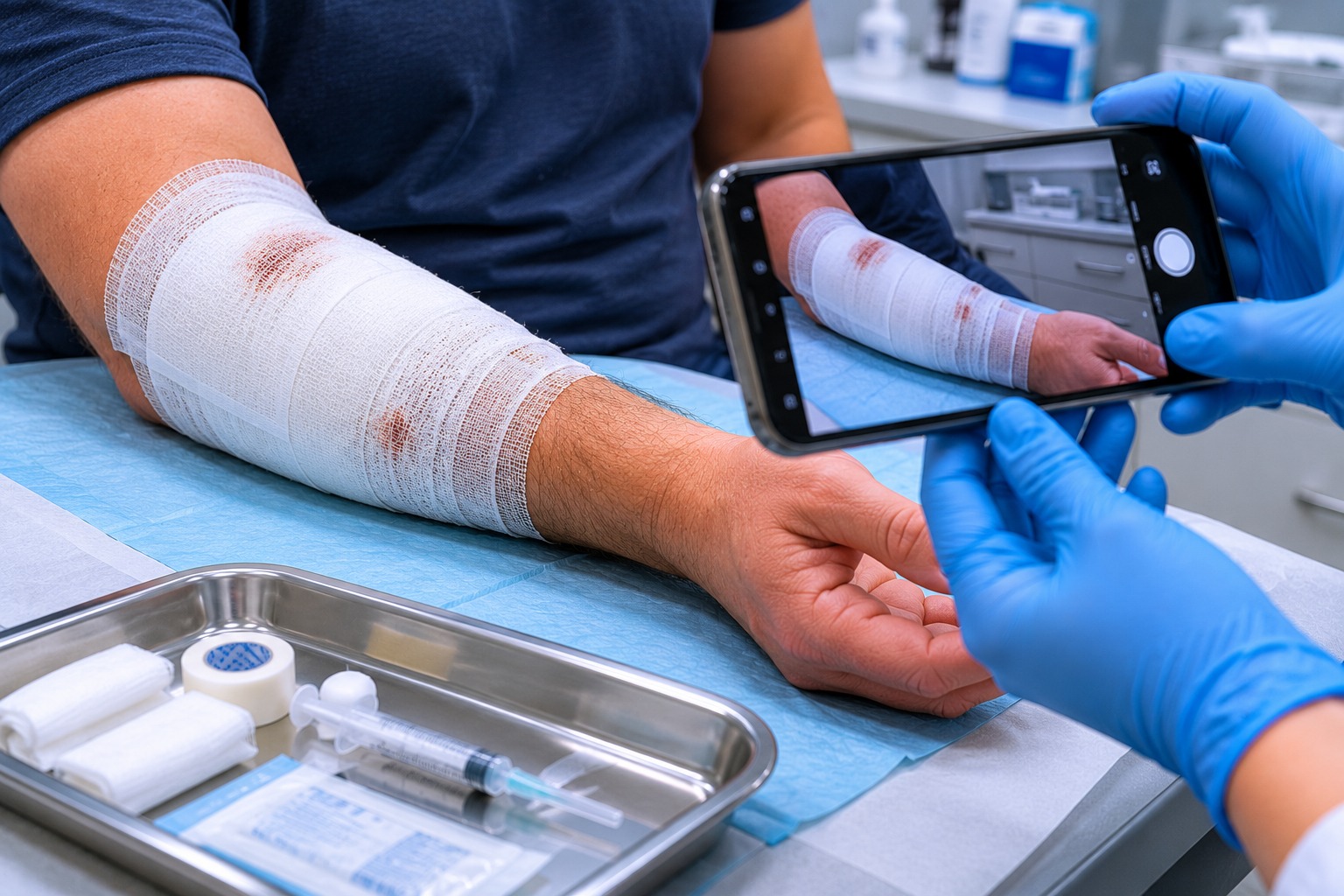
Photos are some of the most underused evidence in dog bite cases — and some of the most powerful. Here’s what to photograph, in priority order:
- The wounds, immediately and over time. Same day if possible, then every few days during healing, then weekly as scarring develops. Date-stamped or with the phone’s metadata intact.
- The dog. If you can safely get a photo of the dog from a distance — in its yard, on its leash — do it. Breed, size, and ID matter.
- The location. Sidewalk, driveway, porch, park — wherever it happened. Get wide shots and close-ups.
- Any property failures. Broken fence, open gate, leash dragging, “Beware of Dog” sign — anything that supports negligence as a backup theory.
- Your clothing. Bloodied or torn clothing is powerful evidence. Don’t wash it — bag it.
3. The animal control report
When you report the bite to animal control, they generate an incident report. Get a copy — sometimes you have to specifically request it, and sometimes you have to wait for the investigation to close. The report typically includes the dog’s ID, the owner’s info, the quarantine status, and the animal control officer’s observations. All of that becomes evidence in your civil claim.
4. The police report (for serious bites)
For any serious bite — hospitalization, surgery, child victim, repeat-offender dog — file a police report too. It’s independent documentation, often more detailed than animal control’s, and a sworn record of what you told law enforcement immediately after the incident. Insurance companies have a much harder time disputing a police-documented version of events.
5. Witness information
Anyone who saw the bite happen, saw the dog before the bite, or saw you immediately after — get their name, phone, address, and a short description of what they saw. Do this within hours if possible. People move, change numbers, and forget details fast. A witness who saw the dog charging at you unprovoked is worth their weight in gold; a witness you can’t locate is worth nothing.
6. The dog’s history
Did this dog bite anyone before? Was it the subject of complaints? Animal control records, neighbor statements, vet records, social media posts — if a pattern exists, it strengthens your case. Even though Michigan’s strict liability statute doesn’t require prior bites, evidence of prior aggression dramatically increases settlement value and forecloses certain defenses.
7. The owner’s insurance information
The dog owner’s homeowner’s or renter’s insurance is typically the source of compensation in a Michigan dog bite case — read the full insurance breakdown here. Get the carrier name, policy number, and claim number as early as possible. If the owner won’t share it, animal control or your lawyer can usually track it down.
8. Your own statements (carefully)
Anything you tell the insurance company becomes evidence — and not always in your favor. Don’t give a recorded statement until you have a lawyer. Don’t post about the bite on social media (we’ll get to why in a moment). Do, however, write down your own version of events while it’s fresh — for your records and your lawyer, not for the insurance company.
9. Documentation of impact
Beyond medical bills, the things that affect your settlement value are the lived consequences: missed work (get a letter from HR), canceled plans, sleep issues, anxiety symptoms, the kid who won’t walk past dogs anymore. Keep a journal. Date entries. Be specific.
The Evidence Mistakes That Cost People Money
Posting about the bite on social media
This is the single most common self-inflicted wound in dog bite cases. The post that says “feeling fine, going to the gym” three days after the bite becomes the insurance company’s favorite exhibit. The angry post calling the owner names creates problems for negotiation. The photos of you laughing at a party become evidence that “the trauma claim is exaggerated.” Stay off social media about the bite. Tell friends and family to do the same.
Throwing away the clothes
Bloodied or torn clothing is corroborating evidence. Throwing it away because it’s gross is understandable; throwing it away because you didn’t think it mattered is a mistake. Bag it, label it with the date, and set it aside.
Waiting too long for medical treatment
The gap between the bite and the first medical visit is one of the first things adjusters look at. A 4-hour gap is normal; a 4-day gap looks like the injury wasn’t that serious. Even if you decided to tough it out, go in promptly. Both for your health and for your case.
Talking to the insurance adjuster before talking to a lawyer
Anything you say can and will be used against you, just like the cop movies say. Adjusters are pleasant and reasonable on the phone because being pleasant and reasonable gets people to say things that hurt their own case. Polite decline, then call a lawyer.
A Time-Based Checklist: What to Do, When
First 24 hours
- Get medical treatment
- Photograph the wounds and the location
- Get the owner’s name, address, phone, and insurance carrier
- Identify witnesses, get contact info
- Report to animal control
- Bag (don’t wash) damaged clothing
- Write your own account of what happened
First week
- File a police report if injuries are serious
- Request the animal control incident report
- Continue photographing wounds as they progress
- Start a daily journal of how you’re feeling, sleeping, functioning
- Talk to a Michigan dog bite lawyer (free consultation, no commitment)
First month
- Request copies of all medical records to date
- Document missed work with employer letter
- Track all out-of-pocket expenses (medications, transportation, etc.)
- If recommended, see a mental health provider for any emotional trauma symptoms
- Resist the urge to settle early — full medical picture isn’t known yet
Frequently Asked Questions
What if I don’t have photos of the bite?
Not fatal — but get them now if there’s anything still visible (scarring, healing wounds). Medical records with detailed wound descriptions can substitute, but photos are stronger.
What if there were no witnesses?
Cases without witnesses absolutely succeed — on the strength of medical records, photographs, animal control documentation, and your own testimony. Witnesses help; their absence doesn’t kill the case.
Do I have to report the bite for my evidence to count?
Not legally, but practically yes — the animal control report is one of the strongest pieces of evidence available, and not having one raises questions. Report.
How long do I have to gather evidence?
Most evidence has a useful life of weeks to months. Michigan’s statute of limitations is three years, but waiting that long to gather evidence is a disaster — the case is already much weaker than it would have been.
Can my lawyer get evidence I can’t?
Yes — medical records subpoenas, insurance information, prior-bite records, vet records, social media records. A lawyer has tools you don’t. But the more you’ve preserved on your own, the more the lawyer has to work with.
Talk to a Michigan Dog Bite Lawyer
If you were bitten in Michigan, we’d rather you talk to us before you talk to the insurance company. The conversation is free and you owe nothing unless we win. We represent dog bite victims throughout Michigan, including Wayne, Oakland, and Macomb counties. Get your free case review today.