
Nerve damage from dog bites is among the most under-compensated and misunderstood categories of Michigan dog bite injury. Solomon Radner and The Michigan Dog Bite Law Firm represent victims with peripheral nerve damage, facial nerve injuries, and permanent loss of function after a dog attack.
Suffered nerve damage from a Michigan dog bite? Get a free case review from Solomon Radner. Nerve damage cases require specialized documentation — we know how to prove permanent injury and recover full damages. No fee unless we win.
Dog bite nerve damage is one of the most overlooked categories of injury in Michigan personal injury practice — and often one of the most permanent. A dog’s teeth can sever, crush, or stretch the peripheral nerves that control sensation and movement. The visible wound heals; the loss of function does not.
This page explains how nerve damage happens in dog bite cases, the medical categories involved, why these injuries are often under-documented, and how The Michigan Dog Bite Law Firm builds nerve damage cases to recover the full compensation Michigan law allows.
How Dog Bites Cause Nerve Damage
Dog teeth are designed to puncture and crush. When a bite lands on or near a nerve, the damage occurs through three primary mechanisms:
- Transection — the nerve is partially or completely severed by the tooth. This is the most serious mechanism and often results in permanent loss of function unless surgical repair is performed within a narrow window.
- Crush injury — the dog’s jaws compress the nerve against bone or other tissue. The nerve remains continuous but loses its ability to conduct signals normally. Recovery is possible but often incomplete.
- Traction injury — the dog pulls or shakes the victim, stretching the nerve. Stretch injuries are common in scalp and limb bites and may take months to fully manifest.
All three mechanisms can produce permanent injury. The severity depends on the bite force, the location, and how quickly the victim received specialized care.
Common Dog Bite Nerve Injuries
Facial nerve damage
The facial nerve (cranial nerve VII) controls the muscles of facial expression. A bite to the cheek, jawline, or temple can sever branches of this nerve and result in permanent paralysis or weakness on one side of the face. The victim may be unable to smile symmetrically, close one eye fully, or move their forehead. This is often combined with significant facial disfigurement.
Hand and finger nerve damage
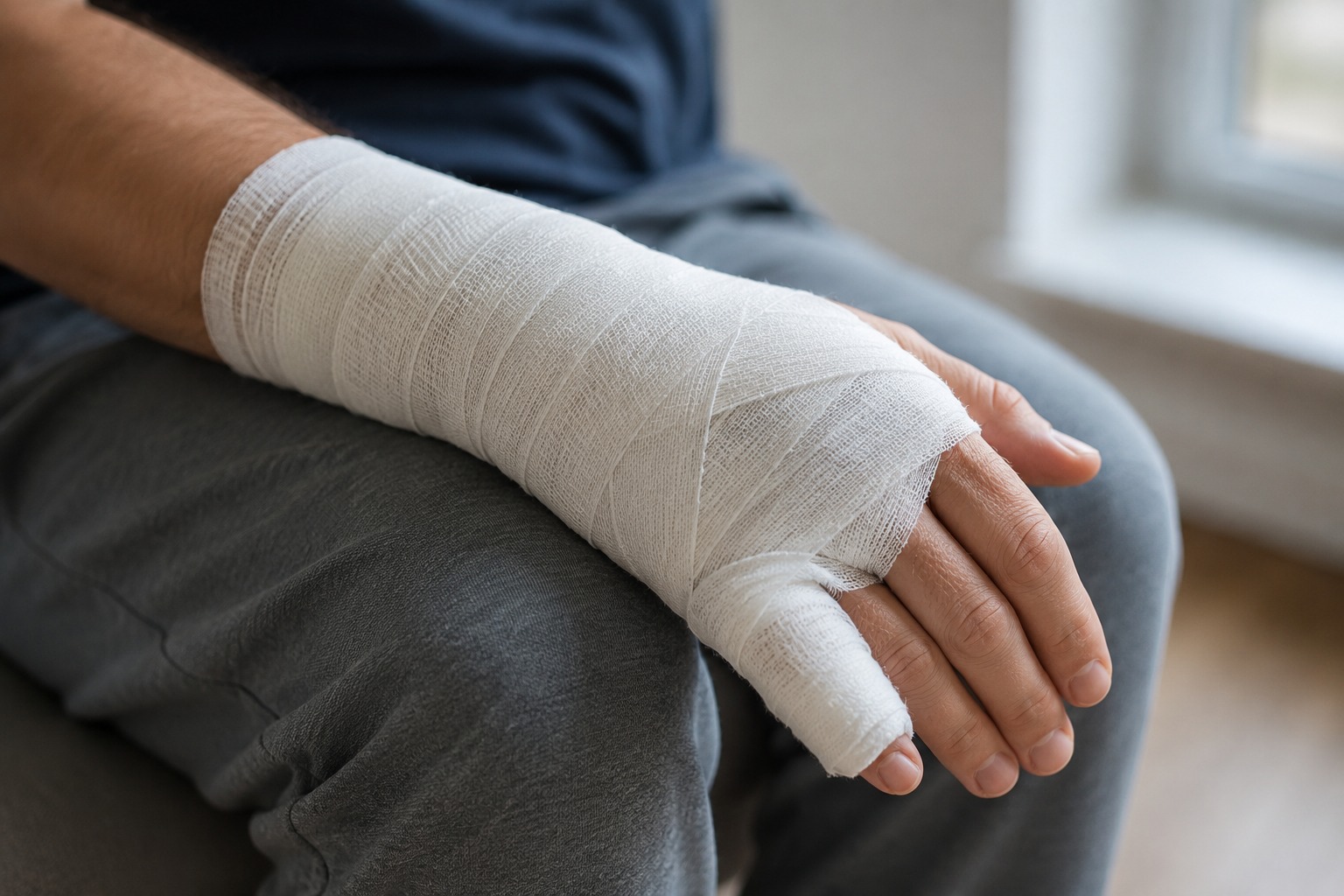
Defensive hand wounds are extremely common in dog attacks. The hand contains a dense network of small nerves controlling fine motor function and sensation. A bite to the palm, finger, or wrist can damage:
- Median nerve — affects thumb, index, middle, and ring finger sensation; controls thumb opposition
- Ulnar nerve — affects ring and little finger sensation; controls hand grip strength
- Radial nerve — controls wrist and finger extension
- Digital nerves — affect sensation in individual fingers
Loss of hand function can be career-ending for many professions — surgeons, dentists, musicians, mechanics, artists, anyone who works with their hands.
Arm nerve damage
Bites to the upper arm or forearm can damage the major peripheral nerves controlling the entire arm and hand. Brachial plexus injuries from large-dog attacks are particularly serious — these are the same nerves injured in motorcycle and football injuries and they often require complex surgical reconstruction.
Leg and foot nerve damage
Lower extremity bites can damage:
- Peroneal nerve — affects foot lift; damage causes foot drop, where the victim cannot lift the toes
- Tibial nerve — affects foot sensation and movement
- Sural nerve — affects sensation in the outer foot and lower leg
Foot drop and gait abnormalities significantly affect mobility and quality of life.
Scalp nerve damage
Scalp bites — particularly common in attacks on children — can damage the supraorbital, supratrochlear, occipital, and auriculotemporal nerves. The result is often permanent numbness, hypersensitivity, or chronic headache.
Symptoms of Dog Bite Nerve Damage
Nerve damage symptoms may not be obvious immediately after the bite. The acute pain and wound treatment can mask the nerve injury for days or weeks. Watch for:
- Numbness in any area near or beyond the bite
- Tingling, pins-and-needles, or burning sensations (paresthesias)
- Weakness or inability to move a finger, toe, hand, or other body part
- Loss of grip strength
- Foot drop — inability to lift the toes
- Facial asymmetry — inability to smile, close an eye, or raise an eyebrow on one side
- Chronic pain at or near the bite site, often described as electric or shooting
- Hypersensitivity — light touch causes pain (allodynia)
- Causalgia or complex regional pain syndrome (CRPS) — a severe chronic pain condition that sometimes follows nerve injury
Any of these symptoms after a dog bite should be evaluated by a neurologist or hand specialist. Early intervention dramatically improves outcomes and is often critical to surgical repair eligibility.
Why Nerve Damage Is Often Under-Documented
This is the most important section of this page. Many dog bite victims with serious nerve damage end up with inadequate settlements because the nerve injury was never properly documented. The reasons:
- The ER focuses on the wound, not the nerve. ER doctors are trained to stop bleeding, prevent infection, and close the wound. Nerve testing is rarely part of the initial visit.
- Symptoms develop later. Nerve damage often becomes apparent days or weeks after the bite, after the victim has been discharged. Victims may not connect the new symptoms to the original bite.
- Standard imaging misses nerves. Routine X-rays and CT scans do not show nerve damage. Specialized testing — EMG (electromyography) and nerve conduction studies — is needed to objectively document the injury.
- Insurance companies exploit the gap. If nerve damage is not documented in contemporaneous medical records, insurers will dispute that it exists or argue it predated the bite.
Building a proper nerve damage case requires referral to the right specialists, objective testing, and expert testimony connecting the nerve injury to the bite. The Michigan Dog Bite Law Firm coordinates this from the start.
What Nerve Damage Victims Can Recover
Under Michigan’s strict liability statute (MCL 287.351), all damages flowing from the bite are recoverable, including permanent nerve damage:
- All medical expenses for nerve testing, surgical repair, physical and occupational therapy, pain management — past and future
- Future medical care for ongoing nerve-related conditions (chronic pain, repeated procedures)
- Loss of function — quantified compensation for permanent loss of sensation, strength, or movement
- Lost wages while recovering or unable to work in the same capacity
- Lost earning capacity — substantial damages when nerve damage forces a career change
- Pain and suffering, particularly significant for chronic neuropathic pain
- Loss of enjoyment of life — activities the victim can no longer pursue
Michigan has no cap on these damages. See our settlement value guide for how these categories are valued in practice.
What to Do if You Have Nerve Symptoms After a Bite
- Get a neurology or hand surgery referral immediately. If you are experiencing numbness, weakness, or any abnormal sensation after a dog bite, ask your primary care physician for a referral to a neurologist or — for hand injuries — a hand surgeon. Time matters: surgical repair of severed nerves has a narrow window.
- Get EMG and nerve conduction studies. These objective tests document the location and severity of the nerve injury and are critical evidence in the legal case.
- Keep a symptom journal. Note daily what activities are affected, what sensations you experience, and how the symptoms change over time. This becomes powerful evidence at deposition or trial.
- Follow all medical advice. Insurance companies use treatment gaps to argue injuries are not serious. Attend every appointment and follow physical therapy schedules.
- Do not give statements to insurance. The dog owner’s insurance will minimize the nerve injury if given the chance. Politely decline and refer them to your attorney.
- Contact a Michigan dog bite attorney with nerve damage experience. Call The Michigan Dog Bite Law Firm at (313) 474-8203 for a free case review.
Why Choose The Michigan Dog Bite Law Firm
Nerve damage cases are won and lost on documentation. The Michigan Dog Bite Law Firm coordinates referrals to the right neurologists, hand surgeons, and pain management specialists from the start of the case. We work with life care planners to project the lifetime cost of permanent nerve injury, and with vocational experts when the injury affects earning capacity.
Solomon Radner is a Michigan Super Lawyer (every year since 2014). The firm operates on contingency — no fee unless we win. The case review is free.
Suffered nerve damage from a Michigan dog bite? Call (313) 474-8203 or request a free case review. No fee unless we win.